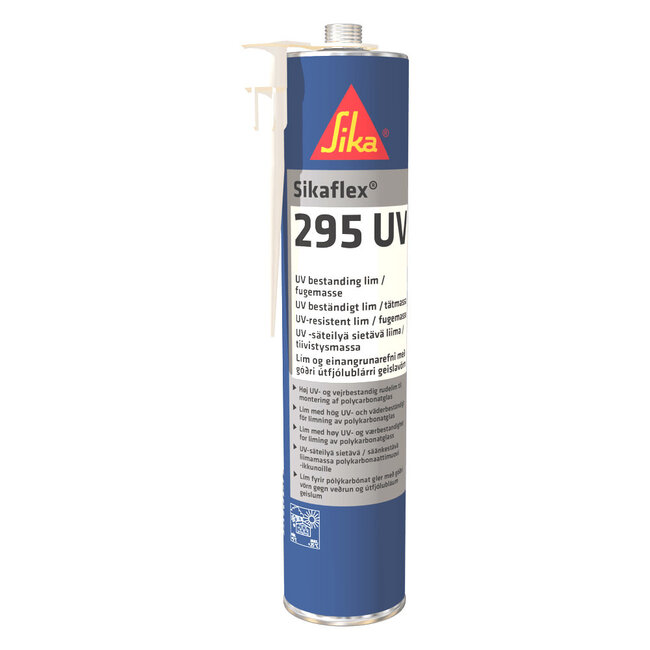
Sikaflex®-295 UV has been specially developed for the marine industry, where it is used to bond and seal plastic glazing materials in boats and ships. Because of its excellent weatherability this product can also be used to seal joints in exposed areas.
Suitable substrates are aluminium (bright or anodized), GRP (polyester resin), stainless steel, timber, 2-component coatings and plastic glazing materials (PC, PMMA). Seek manufacturer’s advice and perform tests on original substrates before using Sikaflex®-295 UV on materials prone to stress cracking. This product is suitable for experienced professional users only.
Test with actual substrates and conditions have to be performed to ensure adhesion and material compatibility.
| Chemical base |
1-component polyurethane |
| Colour (CQP001-1) |
Black, white |
| Cure mechanism |
Moisture-curing |
| Density (uncured) |
1.3 kg/L (10.8 lb/gal) |
| Non-sag properties |
Good |
| Application temperature |
10 °C ─ 35 °C (50 °F ─ 95 °F) |
| Skin time (CQP019-1) |
60 minutes A |
| Open time (CQP526-1) |
45 minutes A |
| Curing speed (CQP049-1) |
(see diagram 1) |
| Shrinkage (CQP014-1) |
1 % |
| Shore A hardness (CQP023-1 / ISO 48-4) |
35 |
| Tensile strength (CQP036-1 / ISO 527) |
2 MPa (290 psi) |
| Elongation at break (CQP036-1 / ISO 527) |
500 % |
| Tear propagation resistance (CQP045-1 / ISO 34) |
5 N/mm (30 pli) |
| Service Temperature (CQP509-1 / CQP513-1) |
-50 °C ─ 90 °C (-58 °F ─ 194 °F) |
| Shelf life |
12 months B |
Surfaces must be clean, dry and free from grease, oil, dust and other contaminants. Surface treatment depends on the specific nature of the substrates and is crucial for a long lasting bond. Suggestions for surface preparation may be found on the current edition of the appropriate Sika® Pre-treatment Chart. Consider that these suggestions are based on experience and have in any case to be verified by tests on original substrates.
Sikaflex®-295 UV can be processed at temperatures (climate and product) between 10 °C and 35 °C (50 °C and 95 °F) but changes in reactivity and application properties have to be taken into consideration. The optimum temperature for substrate and sealant is between 15 °C and 25 °C (59 °F and 77 °F). Consider that the viscosity will increase at low temperature. For easy application, condition the adhesive at ambient temperature prior to use.
To ensure a uniform thickness of the bondline it is recommend to apply the adhesive in form of a triangular bead (see figure 1).